Introduction
Hello, Student!
Technological evolution moves towards making life easier, for this reason, we can observe constantly the development of devices and tools to favour and simplify the daily activities.
Those technologies can also receive an inclusive aspect and allow a major independence of elderly people and/or with disabilities to develop the activities of daily living.
In this context, it is essential to apply assistive technologies (ATs) to improve a deficient functional ability or to help in the execution of the desired function that are currently blocked in consequence of the disability or the aging process.
We invite you to explore this educational resource aiming to approach the concept and the main types of ATs, regarding elderly with disability.
Good Studies!

By the end of this reading, you will be able to recognize the role that the assistive technologies play in the functional rehabilitation of the elderly with disability.
What is Assistive Technology?
The concept of AT is relatively new and is in constant process of formation and systematization. We can understand AT as a vast array of equipments, services, strategies and practices designed and applied to reduce the functional problems faced by individuals with disabilities1.
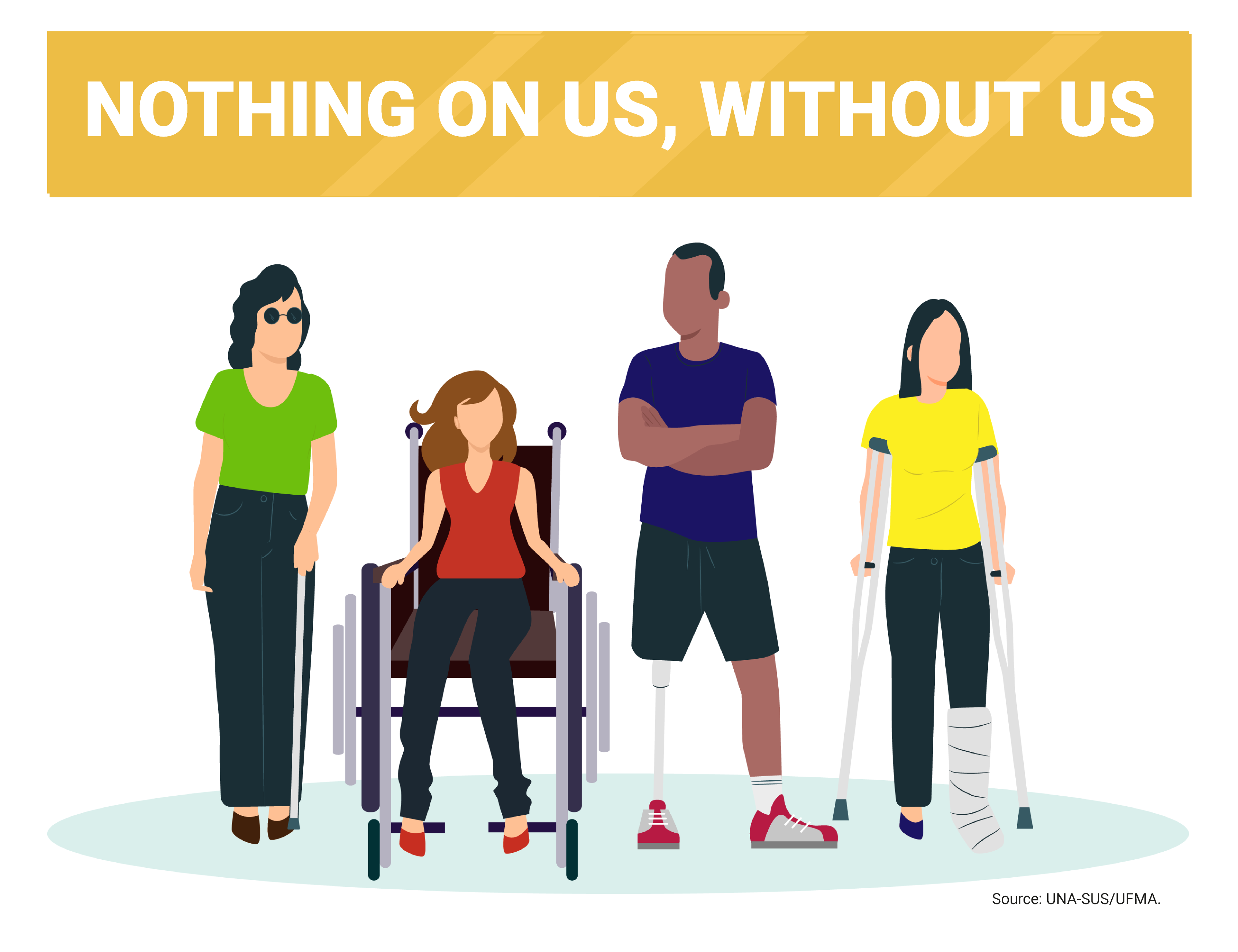
AT includes all the resources and services that contribute to provide or enlarge functional abilities and, this way, promote the independent life and social inclusion1.
On November 16th, 2006, the Special Bureau on Human Rights of the Presidency of the Republic (SEDH/PR) established the Technical Support Committee (CAT), through Ordinance Nº 142, to elaborate a concept of AT that could subsidize the Brazilian public policies. The members of CAT made a thorough revision of the international theoretical background and created the following concept2:
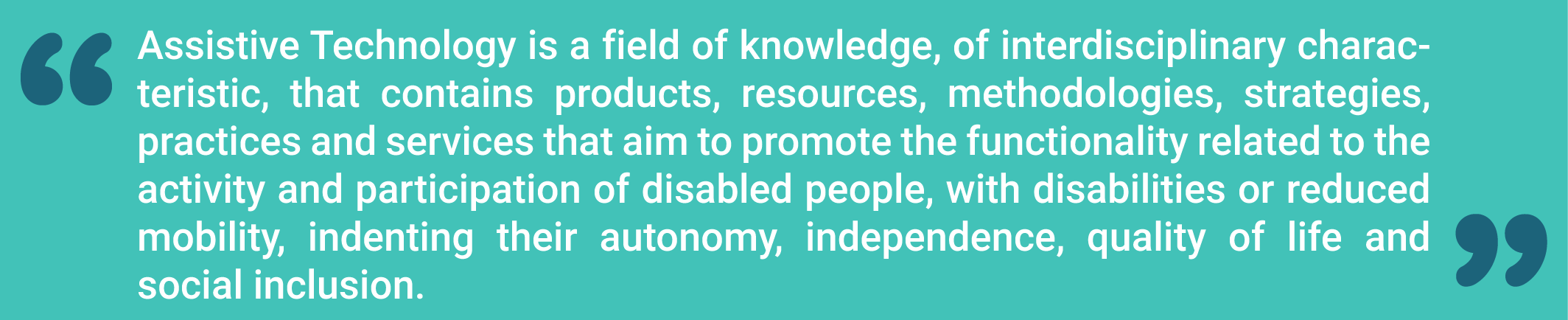
AT presents as objectives: generate accessibility; improve the quality of life; and provide a bigger possibility of independence, motion, education, health, among other aspects.
What are the types of Assistive Technologies?
The process to classify the ATs is complex, however, the Ministry of Treasury, Science, Technology and Innovation, and the National Bureau on Human Rights of the Presidency of the Republic presented a classification in the Interministerial Ordinance Nº 362, dated 24th October 20123. Click on the buttons bellow, to see how the AT can be classified:
Source: BRASIL. MINISTÉRIO DA FAZENDA. Portaria Interministerial n.º 362, de 24 de outubro de 2012. Dispõe sobre o limite de renda mensal dos tomadores de recursos nas operações de crédito para aquisição de bens e serviços de Tecnologia Assistiva destinados às pessoas com deficiência e sobre o rol dos bens e serviços. Available at: https://sintse.tse.jus.br/.... (This content is available in Portuguese) Accessed on: 23 Aug 2021.
We can have AT of high and low technology. Here are some examples of those equipments: Canadian crutches or auxiliary means of locomotion, cane, walker, wheelchair, elevators, adapted cars, orthoses and prostheses, safety bar, ramps and platforms, etc3.
Click on the slides bellow to see some types of AT:
The AT resources must be present in the rehabilitation process, for every user who needs it. Besides, it is necessary a therapeutic recommendation based in safety eligibility criteria 4.
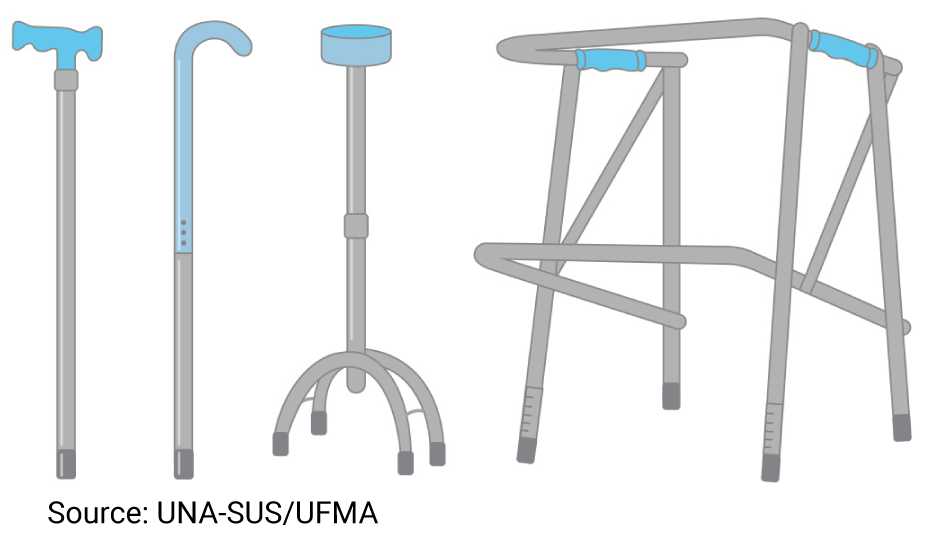
Auxiliary means of gait (canes, crutches and walkers), for instance, are used to improve the mobility function, considering that they aim to reduce the energetic expenditure and to help on balance and weight distribution on lower limbs.
The usage of AT contributes to prevent or diminish the risk of falls and to increase the stability and mobility. In addition, their use favors the access in the community and socialization4.
The Elder must be trained by the professional regarding the correct use of the AT (support standard and adjustments in the device). Besides, the professional must instruct the patient about the measures to preserve the AT. The use based on the recommendation of the qualified professional may4.
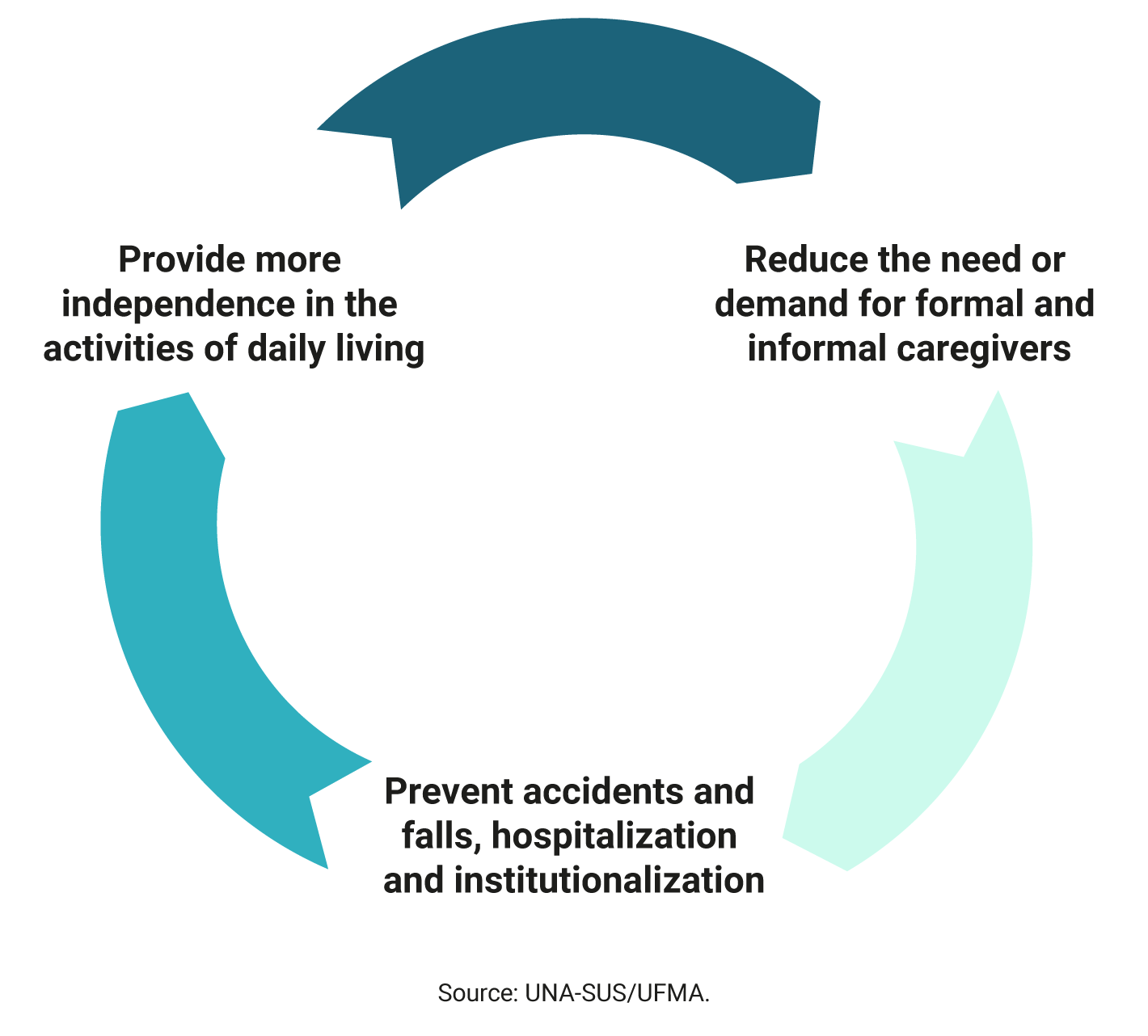
We realize, in this way, that work for the social inclusion of the elderly people means work for the achievement and practice of the citizenship and, in this sense, the AT is an important instrument that cannot be ignored.

To learn more about AT, we suggest the reading of the following documents:
• Assistive Technology, published by the Special Bureau on Human Rights, in 2009; (This content is available in Portuguese).
• Priority Assistive Products List, published by the World Health Organization, in 2016;
• Decree Nº 10,645, of March 11, 2021, which regulates Article 75 of Law Nº 13,146, of July 6, 2015, in order to provide the guidelines, the objectives and axes of the National Assistive Technology Plan. (This content is available in Portuguese).
Final Considerations
Throughout this resource, we approached the concept of AT, the different types of AT and the main benefits of their use among elderly people with disability.
We saw that AT contributes to simplify the daily activity, helps in the social inclusion process, and provides autonomy and the performance of citizenship for those who use it. Besides that, the ATs do not restrict themselves only to objects or physical resources. They also include services, strategies and practices to improve the quality of life of elderly people with disability and for the rehabilitation process.
In this way, we hope that the contents approached here have been useful and that you can apply the new acquired knowledge in your work practice.
Until next time!
References
1 BRASIL. Subsecretaria Nacional de Promoção dos Direitos da Pessoa com Deficiência. Comitê de Ajudas Técnicas. Tecnologia Assistiva. Brasília: CORDE, 2009. 138 p. Available at: http://www.galvaofilho.net/.... Accessed on: 23 Aug. 2021.
2 BRASIL. Ministério da Fazenda. Portaria Interministerial n.º 362, de 24 de outubro de 2012. Dispõe sobre o limite de renda mensal dos tomadores de recursos nas operações de crédito para aquisição de bens e serviços de Tecnologia Assistiva destinados às pessoas com deficiência e sobre o rol dos bens e serviços. Available at: https://sintse.tse.jus. br/.... Accessed on: 23 Aug. 2021.
3 GALVÃO FILHO, T. A. A Tecnologia Assistiva: de que se trata? In: MACHADO, G. J. C.; SOBRAL, M. N. (Orgs.). Conexões: educação, comunicação, inclusão e interculturalidade 1ª ed. Porto Alegre: Redes Editora, p. 207-235, 2009.
4 CAVALCANTI, A.; GALVÃO, C. Terapia Ocupacional: fundamentação e prática. Rio de Janeiro: Guanabara Koogan, 2007.
Credits
Project Coordination
General Coordination of DTED/UNA-SUS/UFMA
Project Management of UNA-SUS/UFMA
Pedagogical Production Coordination of UNA-SUS/UFMA
Educational Offers Coordination of UNA-SUS/UFMA
Information Technology Coordination of UNA-SUS/UFMA
Communication Coordination of UNA-SUS/UFMA
Professor-Author
Technical Validators MS
Angelo Roberto Gonçalves
(CGSPD/DAET/SAES/MS)
Denise Maria Rodrigues Costa
(CGSPD/DAET/SAES/MS)
Flávia da Silva Tavares
(CGSPD/DAET/SAES/MS)
Cícero Kaique Pereira Silva
(CGSPD/DAET/SAES/MS)
Diogo do Vale de Aguiar
(CGSPD/DAET/SAES/MS)
Natália Vargas Patrocínio de Campos
(COSAPI/CGCIVI/DAPES/SAPS/MS)
Wendel Rodrigo Teixeira Pimentel
(COSAPI/CGCIVI/DAPES/SAPS/MS)
Maria Cristina Correa Lopes Hoffmann
(COSAPI/CGCIVI/DAPES/SAPS/MS)
Fernanda Cassiano de Lima
(CGDE/DCCI/SVS/MS)
Fabiana Nunes Carvalho Pisano
(CGDE/DCCI/SVS/MS)
Pedagogical Validator
Translation
Instructional Designer
Graphic Designer
Information Technology
How to quote this material: YUASO, Denise Rodrigues. Assistive Technologies in the Functional Rehabilitation of the Elderly Person with Disabilities. In: UNIVERSIDADE ABERTA DO SUS. UNIVERSIDADE FEDERAL DO MARANHÃO. Program: Healthcare for People with Disabilities I: Autism spectrum disorders, Down syndrome, elderly people with disabilities, amputated people and orthoses, prostheses and mobility aids I. Healthcare for the Elderly Person with Disability. São Luís: UFMA; UNA-SUS; UFMA, 2021.
© 2021. Ministry of Health. Sistema Universidade Aberta do SUS. Fundação Oswaldo Cruz & Universidade Federal do Maranhão. Partial or full reproduction, distribution and utilization of this work is permitted on end-user licensing agreements from the Collection of Educational Resources in Health (ARES). The reference source must be quoted and sale or any commercial purpose, without the authors' expressed consent, is prohibited, according to the Brazilian Copyright Act-BCA (Law n°9,610 dated 19th February 1998).